Deal Intelligence engine room
The shared knowledge graph behind Tribble turns every answer, call, and knowledge update into reusable Deal Intelligence.
You came for faster proposals. Here is what they connect to.
Every RFP answer, call insight, and knowledge update flows through one shared knowledge graph, making every capability stronger with every interaction.
What is Deal Intelligence?
Deal Intelligence is the compounding advantage created when every RFP answer, sales call, buyer question, and outcome feeds one shared knowledge graph, making every team's next interaction smarter than their last.
It is not a CRM. It is not a content library. It is not business intelligence. It is the governed layer that connects proposals, sales conversations, and company knowledge into a system that learns from every deal.
Tribble is not three disconnected AI tools under one logo. It is one intelligence engine with three work surfaces: Knowledge Base, Sales Agents, and Proposal Automation.
A competitive objection captured by a Sales Agent becomes available to the next proposal and the next Slack answer.
When a proposal manager approves a response, that language updates the graph for every future deal touchpoint.
Tribblytics connects answers and deal signals to win/loss outcomes, so the graph learns what actually moves pipeline.
Turns connected content, CRM context, and accepted answers into sourced responses in Slack and Teams.
Call insight captured → RFP objection handled
Prepares, coaches, and captures deal context that becomes reusable intelligence.
Proposal answer accepted → knowledge answer refreshed
Documents, calls, CRM fields, decisions, outcomes, and source provenance mapped to the same graph.
Win/loss signal → next response strategy improved
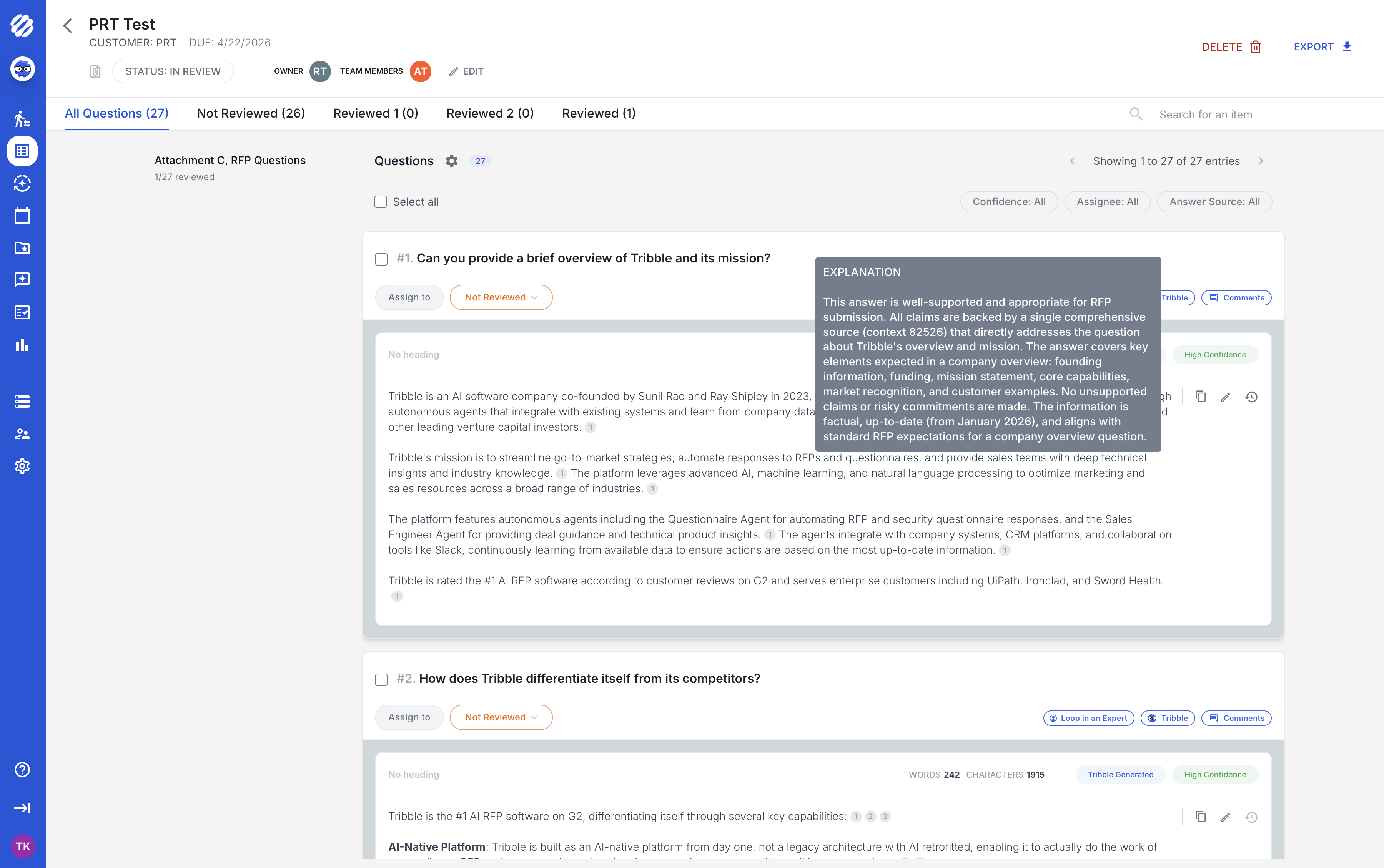
Drafts RFPs, DDQs, and security questionnaires with citations, confidence, and expert routing.
Knowledge update → live call brief sharpened
Connects answer-level activity to pipeline outcomes so the platform knows what wins.
The graph is where content, calls, CRM data, expert decisions, and outcomes become one reusable intelligence layer.
Gong, Salesforce, SharePoint, Confluence, Slack, Teams, Drive, Box, and other sources feed the same permission-aware graph instead of separate point-solution databases.
Accepted answers, SME edits, call insights, competitive objections, and win/loss tags become learning events that improve the next response, brief, and knowledge answer.
A pricing objection captured on a call can show up in the next RFP answer. An approved security response can sharpen the next rep brief.
Separate tools may integrate, but they do not learn as one system. Tribble makes every connected surface feed the same Deal Intelligence graph.
of answers now draw from live call insights captured in the last 30 days.
average time from new insight captured on a call to that insight appearing in an RFP response.
Tribble does not just connect to your stack. It makes every connected system contribute to the same Deal Intelligence graph.

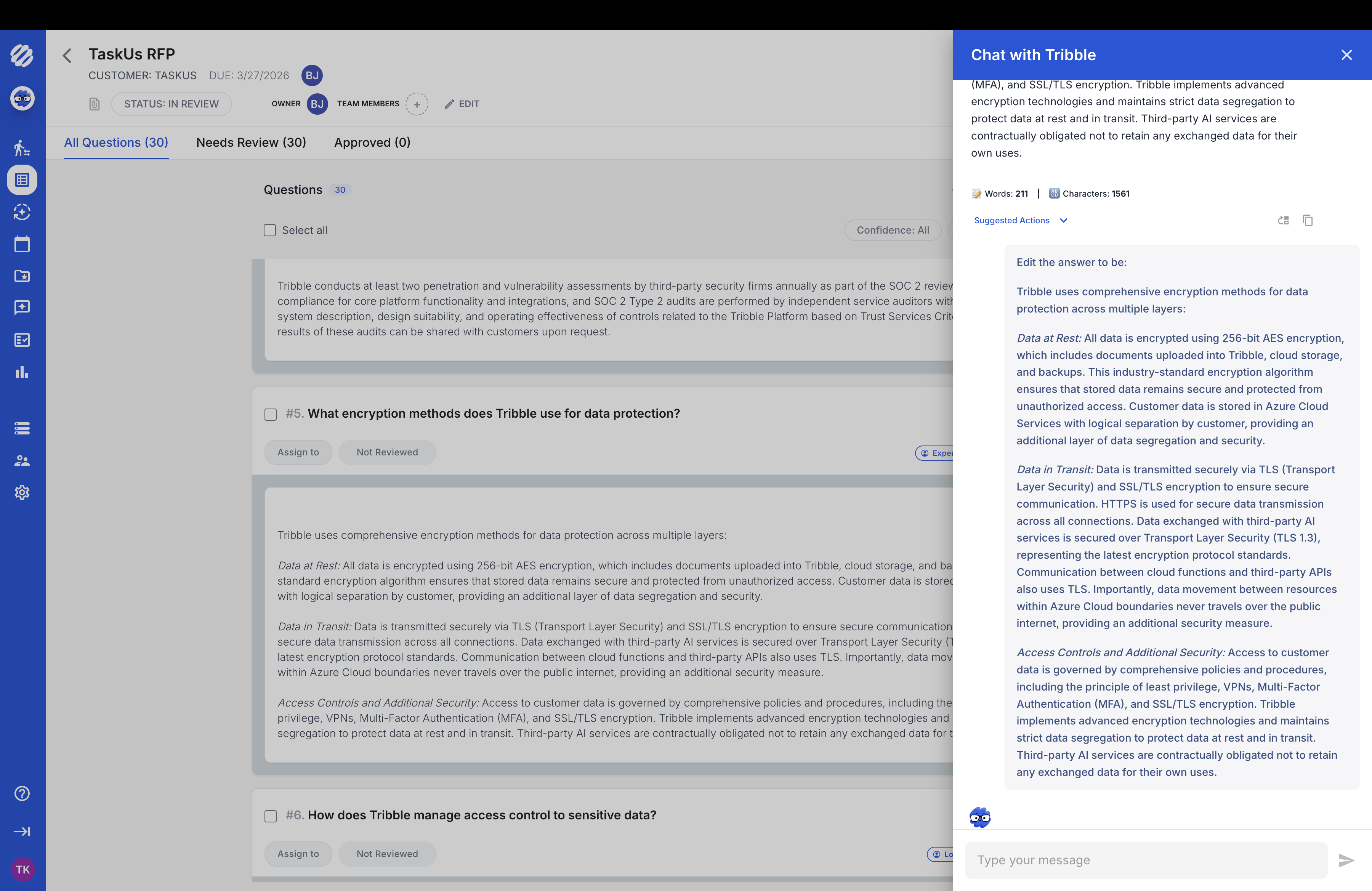
The Knowledge Base is the graph's daily interface: sourced answers in Slack and Teams, enriched by CRM context, call insights, accepted proposal language, and current source documents.
“Our reps stopped asking each other and started asking Tribble. Same answers, every time.”
VP of Sales, Enterprise SaaS
CRM, docs, calls, and accepted responses become one permission-aware graph.
Sourced responses include the latest approved language and relevant deal context.
Accepted answers and corrections sharpen proposals, call prep, and future knowledge retrieval.
Real RFP questions. One answered by generic AI. One answered by Tribble, with deal intelligence from your calls, CRM, and competitive data woven in.
We'll run your actual RFP questions live
“The best sales tools disappear into the work. Tribble is the first one that actually did.”Rachel M. · Head of Revenue Operations
Sales Agents use the shared graph for deal prep and coaching, then push new objections, customer language, and follow-up commitments back into the same intelligence layer.
Briefs draw from CRM, past proposals, sourced knowledge, prior calls, and outcome patterns.
Competitive intel and objection handling use the same approved language proposal teams trust.
Follow-ups, CRM updates, objections, and commitments become graph updates for the next deal.
Your team asks questions in Slack. Tribble answers with citations, not guesses.
“My new hires sound like they’ve been here two years. That changes everything.”Priya N. · VP Sales, Enterprise Software
Proposal Automation draws from the graph to draft RFPs, DDQs, and security questionnaires, then sends approved language, SME edits, and answer outcomes back into the system.
“We went from dreading RFPs to treating them like a competitive weapon.”
VP of Sales, Financial Services
Every response can use current docs, CRM context, call insights, and approved prior answers.
SME corrections become graph updates, not one-off comments trapped inside a project.
Tribblytics tracks outcomes at the answer level so future proposals and call briefs know what wins.
Deal Intelligence only works if every team can trust the sources, permissions, and audit trail behind the answer.
Tribble keeps customer data isolated to your workspace and uses security controls designed for regulated sales workflows.
These stat blocks are ready for validated pipeline data and customer proof once Melissa's numbers land.
higher win rate when teams use live Deal Intelligence instead of a static answer library.
average time from a competitive objection captured on a call to being handled in the next RFP response.
of proposals that include insights captured from customer conversations in the last 30 days.
increase in answer reuse across proposals within 90 days as insights flow automatically between capabilities.
“The system knows more than any single person because every call, proposal, and outcome keeps teaching it.”
Placeholder customer quote - Melissa pipelineDDQ automation · Investor reporting · Regulatory questionnaires
Explore →Health system RFPs · HIPAA questionnaires · Clinical assessments
Explore →Security questionnaires · Technical evaluations · Vendor assessments
Explore →Public sector RFPs · Compliance documentation · Procurement portals
Explore →Carrier RFPs · Broker questionnaires · Regulatory submissions
Explore →Bring a real RFP, call, or knowledge question. We’ll show how the same graph powers answers, briefs, expert routing, and outcome learning on your data.
★★★★★ 4.8/5 on G2 · SOC 2 Type II · 40+ Integrations · 48-Hour Onboarding